
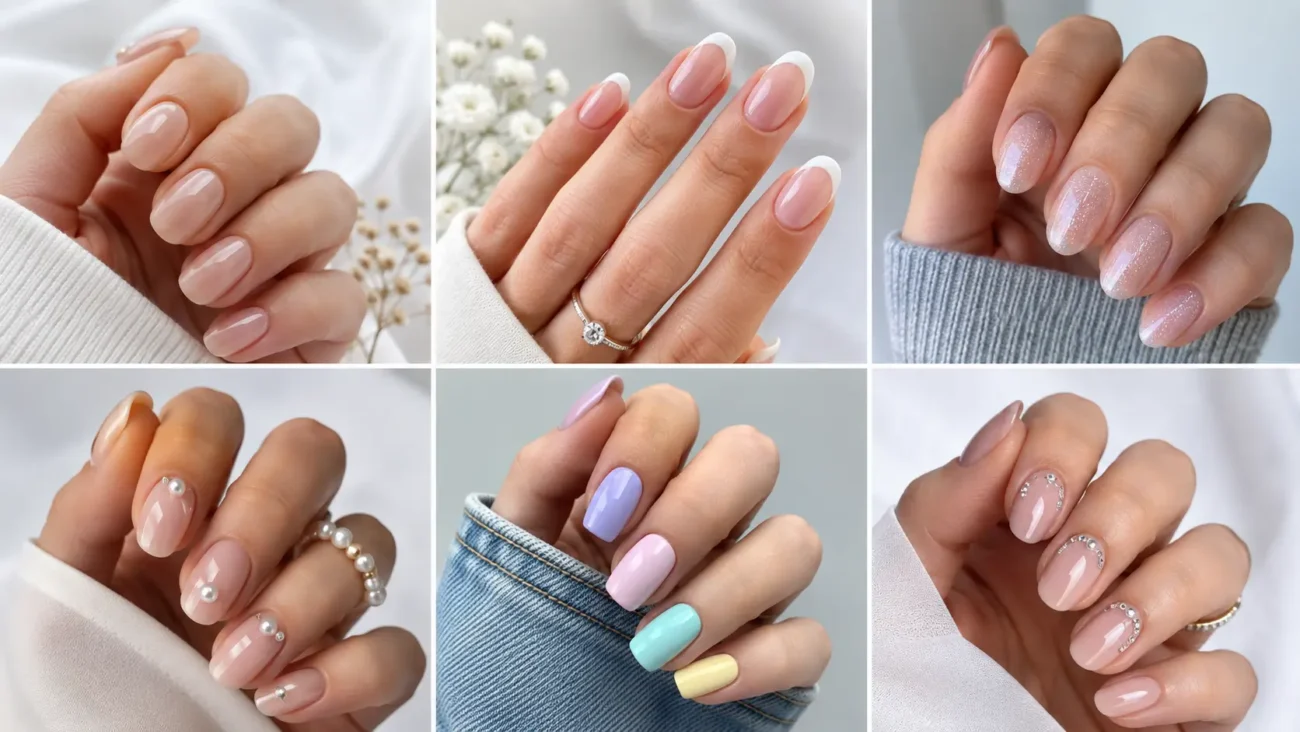
Graduation deserves a manicure connected to the ceremony without relying on predictable gold tips, scattered gems, or identical cap drawings. These nails for graduation ideas explore honor cords, diploma folios, academic hoods, tilted mortarboards, auditorium seating, and class ring details through fresh compositions.
Each theme includes three variations for short squoval, rounded, almond, coffin, or medium square nails. Choose colors from the gown, stole, hood, or school palette, then vary the placement so every finger contributes something different while the complete set stays polished in photographs.
Honor Cord Nails With Braided Color and Ceremony Movement
Honor cord nails transform ceremonial cords into flowing color paths. Use school shades, society colors, or a quiet combination of ivory and navy. Instead of bulky rope decorations, create controlled painted strands, shallow grooves, and compact knots that follow the nail shape.
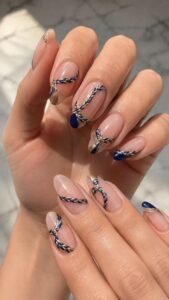
Long almond nails support extended curves, while short squoval nails can show one cropped crossing near the side.
Twist Two School Colors Through the Center
Paint a soft neutral base, then guide two narrow color strands from opposite sides of the cuticle toward the center. Cross them twice before allowing each shade to leave through a different edge. Small curved highlights make the strands appear rounded.
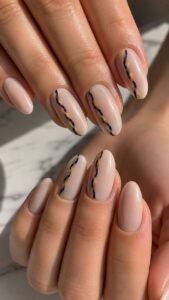
Keep the tip mostly open so the braided section remains clear and does not resemble an ordinary striped manicure.
Gather Three Cords Into a Side Knot
Place three slim strands along one side using related tones such as cobalt, cream, and burgundy. Bring them together near the lower third and form one compact looped knot. Let the ends separate slightly as they move toward the tip.
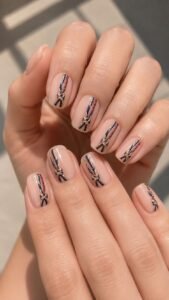
This side placement creates ceremony detail without covering the entire surface, making it suitable for shorter nails.
Create a Tassel End From Fine Threads
Use a deep solid base and paint one cord descending from the cuticle before opening into several fine threads near the tip. Keep the threads different in length and place a narrow band where they separate.
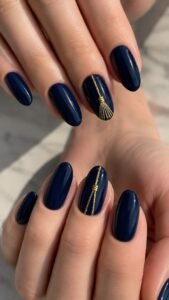
A second finger can show only the band and two threads, allowing the idea to travel across the hand without repeating the full tassel.
Diploma Folio Nails With Rolled Paper and Ribbon Structure
Diploma folio nails focus on crisp paper edges, wrapped ribbons, and formal presentation covers instead of readable names or dates. Cloud white, parchment, black, oxblood, and university blue create a ceremonial mood.
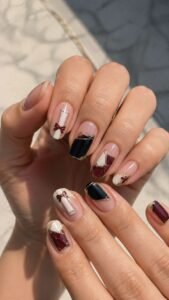
Square and coffin shapes support folded corners, while rounded nails can carry cropped scroll sections. Keep every element flat and sharply finished so the design looks elegant beside formal clothing and jewelry.
Roll Parchment From the Outer Edge
Apply a muted university color, then paint a parchment section curling inward from one side. Use a cream inner curve and a slightly deeper beige outer edge to show the roll. Stop the paper before the center so the background remains visible.
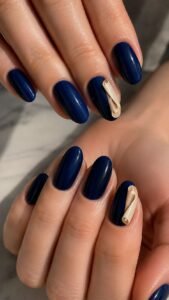
The cropped view suggests a diploma without relying on printed words, seals, or miniature lettering.
Wrap a Satin Ribbon Around White
Cover the nail in soft white and place one broad satin colored ribbon across the lower third. Fold one end underneath using a darker shadow, then allow the other end to angle toward the side.
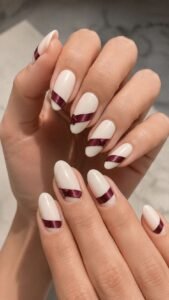
Choose burgundy, forest green, navy, or violet according to the outfit. A smooth finish keeps the folded ribbon refined rather than gift inspired.
Open a Dark Folio at the Tip
Paint a deep black or oxblood panel entering from the tip, then divide it with one narrow center fold. Add a small parchment corner inside each side so the shape appears partly open. Leave the lower half in a sheer neutral.
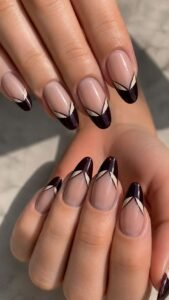
This composition gives longer nails strong structure while keeping the cuticle area soft and photograph friendly.
Academic Hood Nails With Layered Regalia Color
Academic hood nails borrow the curved panels and contrasting linings found in formal regalia. They create graceful color placement without ordinary diagonal blocks. Velvet black, ivory, and one strong faculty shade can shape the design, while softer versions use taupe, dusty blue, or muted plum.
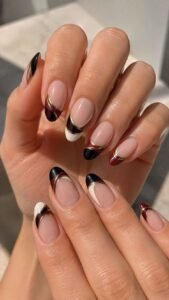
The curves can frame the tip, cuticle, or side for minimal or expressive manicures.
Frame the Cuticle With a Velvet Curve
Begin with a sheer beige foundation and paint one broad black curve around the cuticle, leaving a narrow opening at the center. Add a smaller faculty color inside the black border.
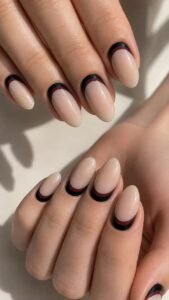
Keep the upper nail clear so the curved regalia detail appears tailored and intentional. This arrangement works especially well on rounded and almond shapes.
Fold a Lining Panel Across One Side
Use ivory as the base and place one deep color panel entering from the outer edge. Give the inner boundary a long inward curve, then add a slim black section behind it to suggest layered fabric.
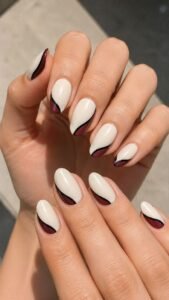
Position the fold lower on one nail and higher on another so the hands feel coordinated without becoming symmetrical.
Layer Three Regalia Tones at the Tip
Build three curved bands across the tip using black, a school color, and a narrow ivory division. Make the center band widest and let the outer bands taper near the sides. The result should resemble layered academic fabric rather than a familiar tip design.
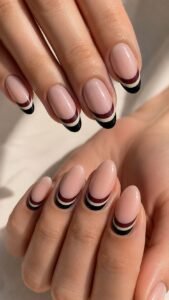
A satin topcoat can strengthen the soft textile mood without adding actual fabric texture.
Mortarboard Angle Nails With Cropped Cap Geometry
Mortarboard nails feel fresher when the cap becomes an abstract arrangement of diamonds, edges, and swinging tassel paths. Matte black, midnight blue, cream, and one bright school shade keep the shapes clear.
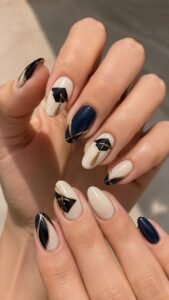
Divide the cap parts across the manicure instead of repeating a complete image. Short nails suit cropped corners, while longer shapes support an extended tassel route.
Tilt a Black Diamond Beyond the Corner
Paint a pale neutral base and place one black diamond partly beyond the upper corner. Add a small matching square beneath its visible center to suggest the crown.
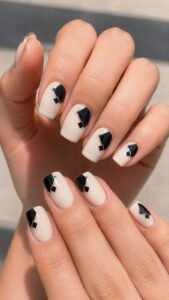
Cropping most of the cap gives the image stronger scale and prevents it from looking like a sticker. One school color edge can connect it with the graduation outfit.
Swing a Tassel Across Bare Space
Use a sheer base and draw one curved cord beginning outside the side of the nail. Guide it across the center, then finish with a compact tassel near the opposite tip. Leave generous bare space around the path.
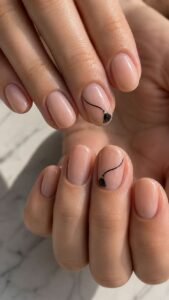
The open composition captures movement and keeps the direct graduation symbol light enough for short natural nails.
Stack Cap Edges Into a Graphic Pair
Apply a school color base and add two black diamond corners at different heights. Let one enter from the cuticle side and the other from the tip, without allowing them to touch. A small cream point between them creates visual separation.
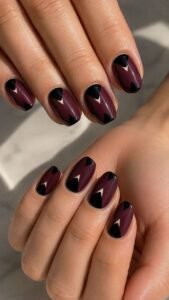
This paired arrangement refers to multiple graduates while avoiding faces, figures, or repeated complete caps.
Auditorium Row Nails With Ceremony Seating Rhythm
Auditorium row nails capture orderly seating, center aisles, and reserved chair details. Burgundy, navy, forest green, warm wood, and cream can form compact rows without resembling a checkerboard.
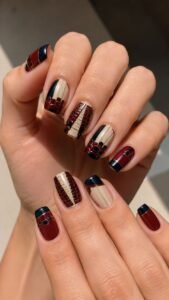
The perspective lengthens the nail, making this theme useful for square, squoval, or coffin shapes. Use fewer seats on short nails and wider spacing on longer versions.
Arrange Burgundy Seats Toward a Center Aisle
Paint a warm neutral background and place two rows of small burgundy seat shapes along both sides. Leave a clear aisle running toward the tip and make the upper seats slightly smaller to create distance.
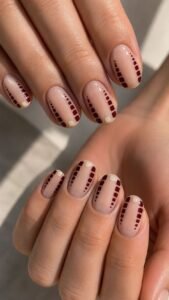
Add one cream seat in the front row as a subtle focal point. The perspective gives the manicure depth without raised decoration.
Mark a Reserved Chair With School Color
Use deep navy across the nail and add three simple cream seat backs near the lower half. Fill one center panel with a strong school shade, making it appear specially reserved.

A small matching block on another finger can continue the idea. Keep all outlines broad enough to remain readable in photographs and on compact nail shapes.
Curve an Aisle Around the Outer Edge
Begin with a muted wood tone and paint one sweeping cream aisle that starts near the cuticle and widens toward the side of the tip. Place several dark seat backs along the inner curve.
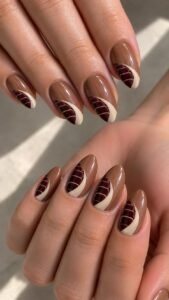
The changing width creates movement through the ceremony space. This version suits almond nails because the aisle can follow their naturally narrowing outline.
Class Ring Nails With Signet Shape and Personal Color
Class ring nails translate the broad signet face, engraved shoulders, and colored center of graduation jewelry into polished nail art. Flat geometry keeps the concept modern without imitation gems.
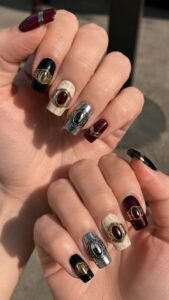
Antique gold, silver gray, black, cream, and one school color create a formal palette. Use the complete signet sparingly, then distribute smaller ring details across the remaining nails.
Center a School Color Signet Panel
Apply a warm cream or sheer nude base and paint one broad octagonal panel in the center. Fill it with the school color, then surround it with a narrow antique gold border. Keep the center unlettered so the shape remains clean.
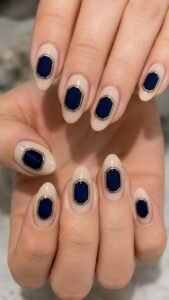
A soft shadow beneath one edge gives the signet presence without using stones or raised metal pieces.
Shape Engraved Shoulders Along Both Sides
Use a dark base and paint two gold or silver sections entering from opposite sides. Taper them toward the center while leaving a small open space between their inner ends. Add one simple recessed line inside each shoulder.
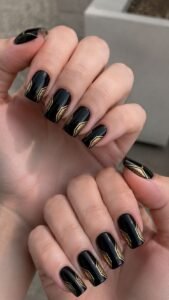
This cropped arrangement suggests a ring band viewed closely and works particularly well on short square nails.
Create a Two Tone Ring Profile at the Tip
Paint the lower nail in a quiet neutral and build a wide ring profile across the tip using brushed gold and silver gray. Separate the metals with a narrow school color section in the middle.
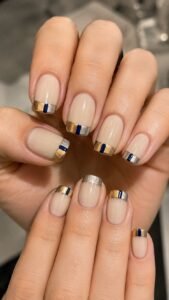
Keep the edges rounded rather than perfectly straight. The mixed finish complements graduation jewelry while remaining distinct from chrome, glitter, or gemstone manicures.
Let Your Graduation Nails Hold Part of the Celebration
The best nails for graduation feel meaningful in photographs without distracting from the gown, diploma, jewelry, or proud moment. Honor cord paths bring color and movement, while diploma folios introduce ceremonial structure. Academic hood layers connect with regalia, and mortarboard angles create recognizable geometry. Auditorium rows capture the shared ceremony, while class ring details celebrate achievement. Choose the theme that fits the school colors and preferred length, then adjust the intensity for a quiet or expressive finish. Related articles about graduation outfits, hairstyles, makeup, jewelry, acrylic nail shapes, short manicures, and celebration styling can complete the look.